


Welcome to Narrative News, your must-read source for all things game narrative design! Every month we publish one feature at the beginning of the month and one roundup of jobs, resources, and opportunities mid-month.
There are many things that are opaque about the games industry, especially to those just starting out. How do I make a portfolio? How do I network (without wanting to explode into a million particles of cringe)? Should I get a MFA/MA? Should I try AAA or go indie? Is there even going to BE a games industry for me to work in when I graduate?!
I’m writing a piece on that last question as you read this (short answer, yes—with asterisks), but today we address the question of indie vs. AA vs. AAA.
First off, let’s do some definitions.
Indie: For my purposes, I’m going to define indie as super small teams ranging from solo devs (Lucas Pope) to duos (Killmonday) to teams with 15 or fewer core devs (Team Cherry). Indie teams generally have limited funding—whether from a publisher, a grant, personal savings, or a benevolent partner who is willing to pay the rent. That’s my definition of indie and I’m sticking to it (*loud, angry mob gathers outside my apartment*).
AA: Think 15-50 core devs plus a few teams of contractors/co-devs. Sandfall Interactive, makers of Clair Obscur: Expedition 33, was a team of about 34 core devs, but over 200 individuals were listed in the credits. These teams have much more funding than indies generally, but not the eye-watering amounts pumped into AAAs.
AAA: Comparable to a major Hollywood studio. Development and marketing budgets frequently top $100 million and there are TONS of people working on the same game, generally 300 plus. Examples: GTA 6, Cyberpunk 2077, Red Dead Redemption II.
There are plenty of ways to argue pedantically about these definitions, but let’s just roll with them for the purposes of the article, yes? Yes.
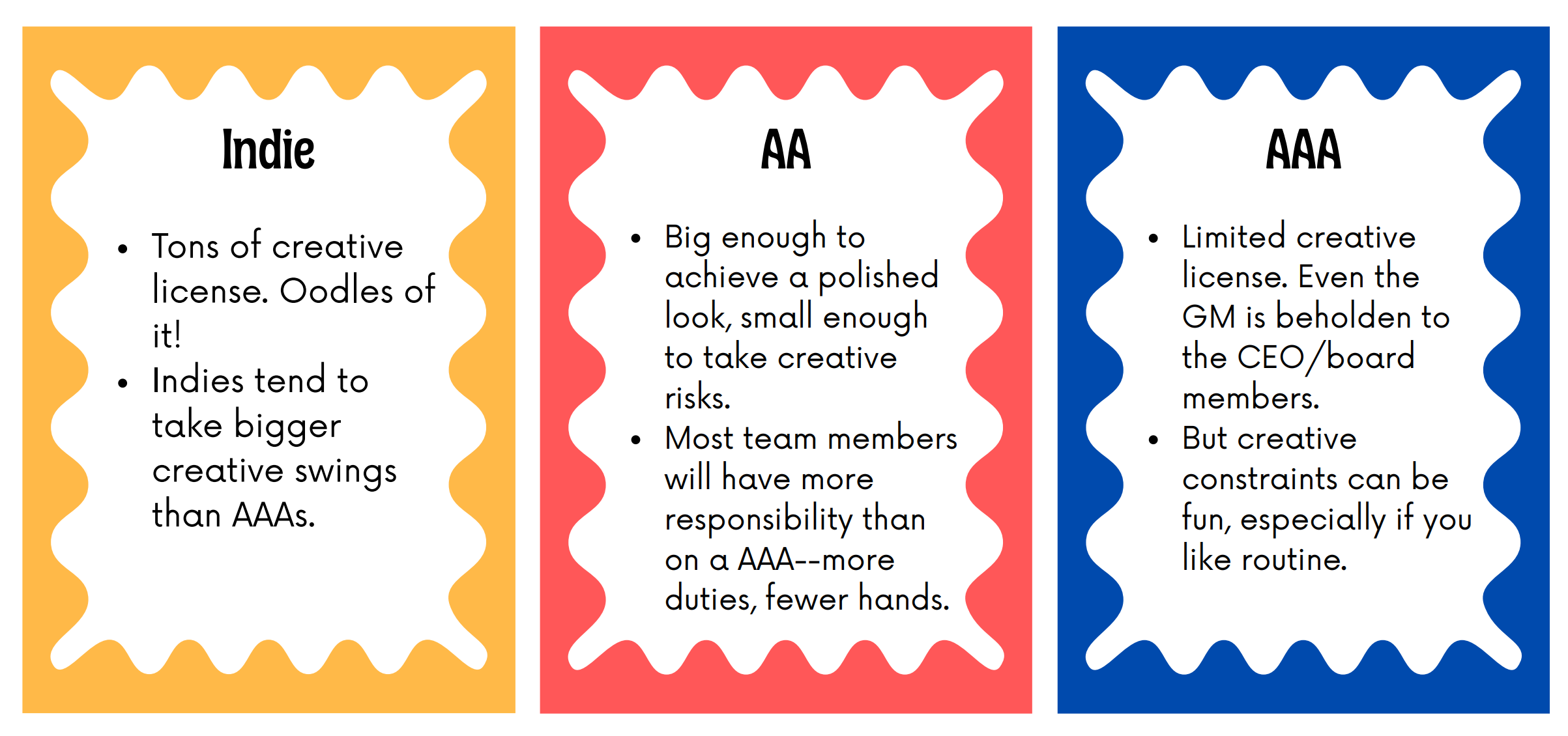
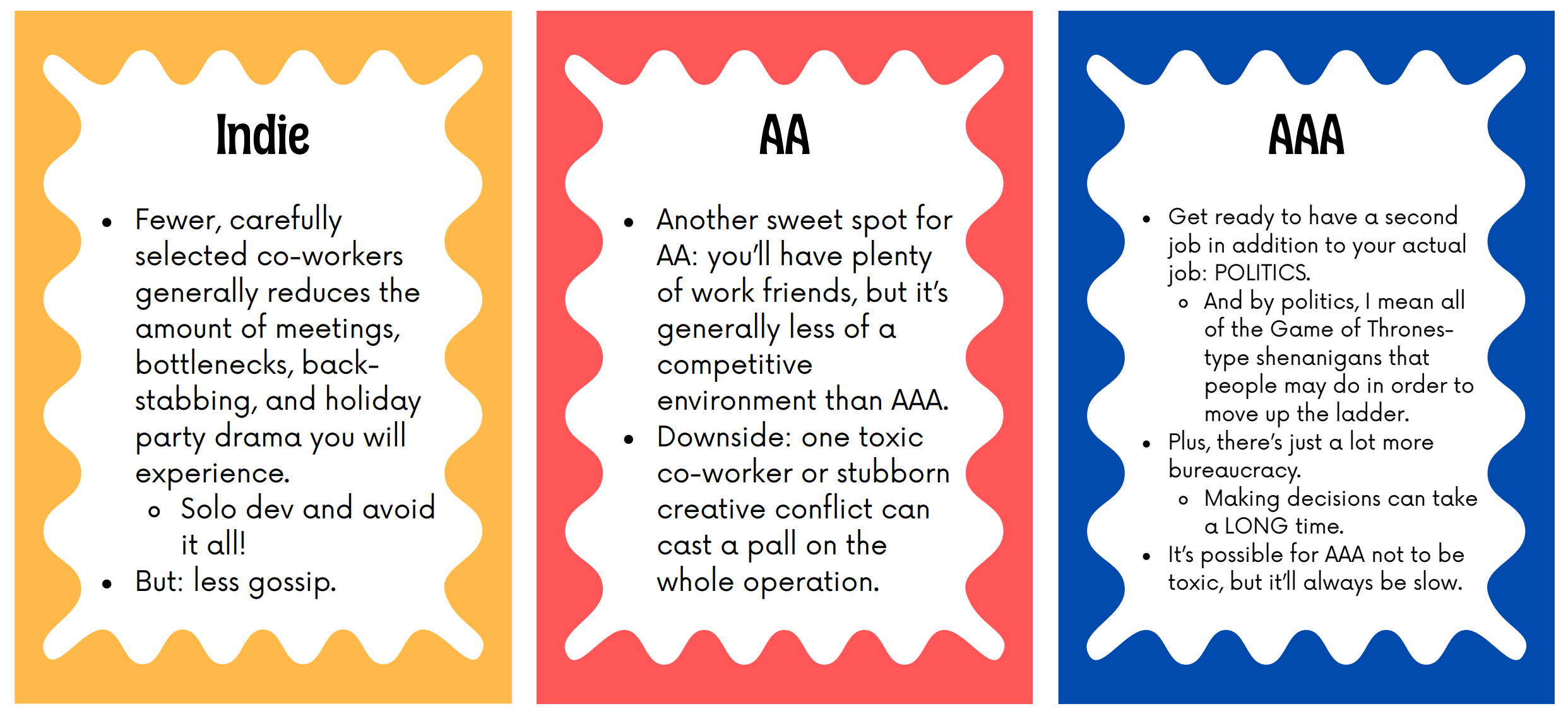
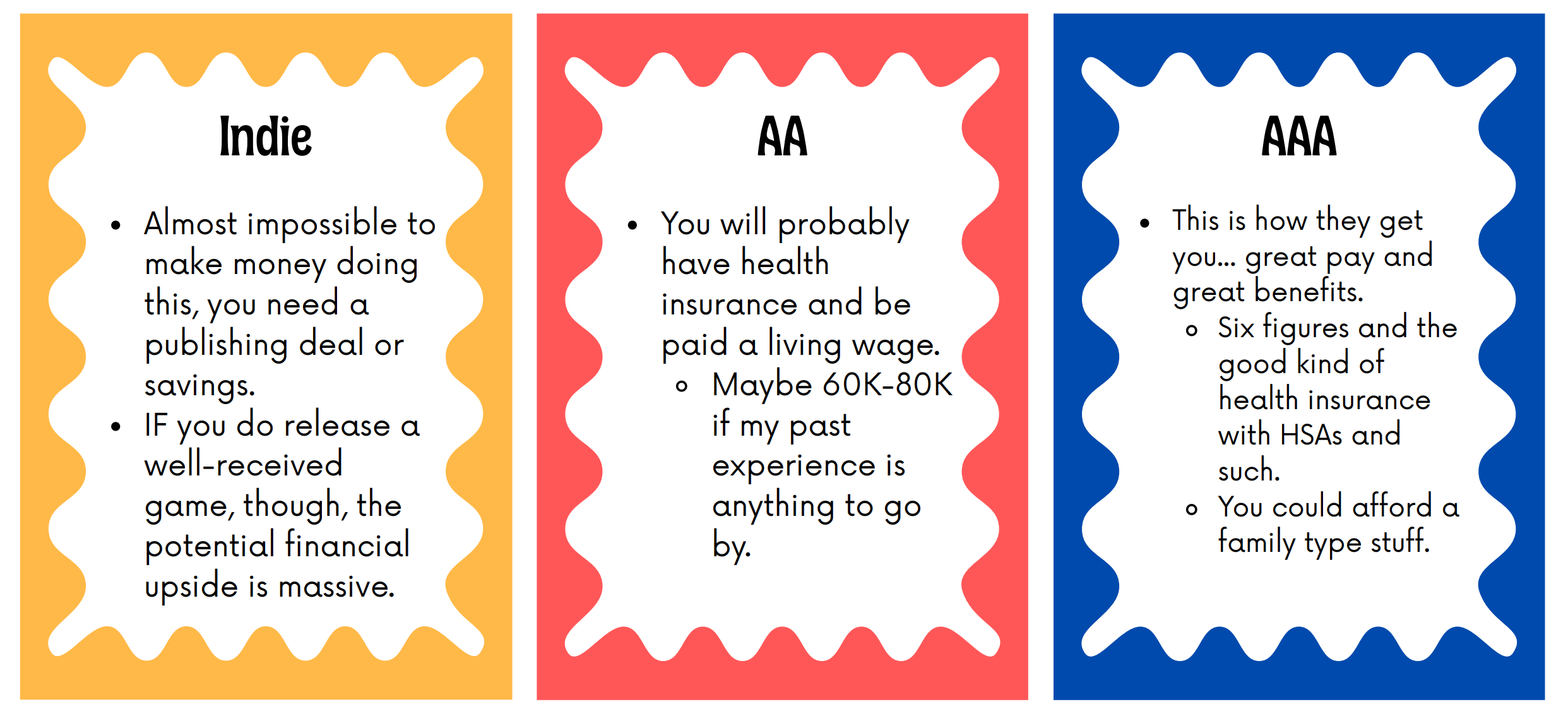
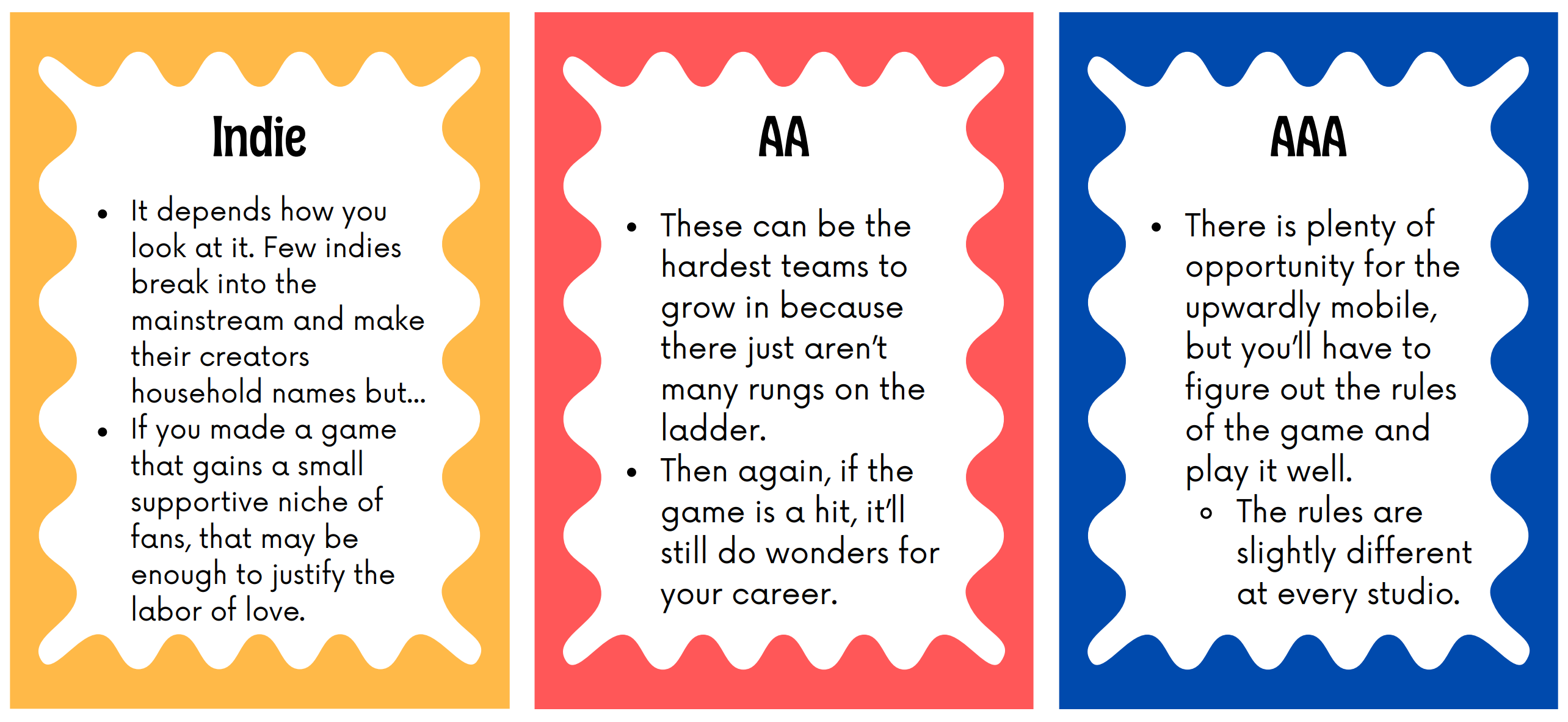
I’ve been lucky enough to work in all three of these areas of game development, and I can tell you firsthand: they are very different working experiences. To shed a bit more light on why they are, I’ll compare them across four different areas: creative license, political maneuvering, pay/benefits, and upward mobility.
Creative License
Political Maneuvering
Pay/Benefits
Upward Mobility
Bonus: Stability
Unfortunately, if you want stability, you won’t find it in AAA, AA, or indie games—at least not in the current market, but really it’s never been a safe career bet.
Just like any creative career, being in games is demanding, competitive, feast-or-famine type work. Sometimes you have a great gig and you save and stockpile and sometimes you get hit by a layoff or a cancellation and you find yourself weathering the storm.
I do think it can and should be made better for future generations (go UVW-CWA!) but I also want to give an accurate account of the current state of affairs: stability is not something you’re guaranteed to find anywhere.
It does build somewhat over time, though. Not job stability, but career stability. Thanks to the jobs I’ve had over the last six years, I’ve got savings and connections that would help me stay afloat if/when another upheaval comes down the pike. And I truly, honestly love what I do every day.
With all that said, I hope I haven’t dissuaded anyone from getting into games—it’s a wonderful art form, and I truly believe we need every unique voice and talent we can get to push this art form further and discover the limits of what’s possible in the realm of interactive storytelling. I, for one, don’t believe we’ve even begun to breach them.
Before you leave… check out a few time-sensitive opps and jobs:
Apply for the Dames 4 Games March showcase.
Enter for a chance to get a free pass to GDC courtesy of Amir Satvat.
A cool opportunity for Paris-based narrative designers (or those willing to relocate). Audio games for a youth audience!
Narrative design gig in New Zealand for an original IP.
Narrative design gig at Vizzy Labs — it is using AI for video but the writing is human.
Thanks for reading! Pass on the good vibes and share this newsletter with other narrative designers.
About the Writer:
Rose Behar is a narrative designer at Scopely working on an upcoming AAA project. Her previous work is featured in Longleaf Valley and Ashe Cove, among other projects. She puts out the free Narrative News roundup twice every month.
About the Illustrations:
The beautiful illustrations dotted throughout the newsletter were created by Callum Isaac.